What procurement can conclude about Dlp Printer after reviewing trade-off framing for shortlisting
Choosing a dlp printer for a project is not a matter of ranking one headline specification. Procurement needs a decision record that connects the intended use, available space, operating workflow, materials, and acceptable operator involvement. The useful question is narrower: which documented capabilities matter for this project, and which conclusions remain open until suppliers provide more detail?

Clarify the decision before comparing products
Start with the project outcome rather than the machine label. A team producing detailed prototypes may prioritize a different combination of process control and post-processing steps than a team building repeated parts. The requirements should state the type of parts, expected degree of detail, material route, operator skill, and location of the equipment.
Space planning should cover more than the printer footprint. Resin handling, model removal, washing, curing, and storage can all affect the usable work area. The procurement brief should therefore describe the complete workflow. It should also identify who will load material, remove parts, perform post-processing, clean the equipment, and record process information.
This approach prevents a common shortlisting error: treating a page-listed feature as proof that the entire application is suitable. A feature can be relevant without answering every integration, quality, or workload question. Keep three columns in the evaluation record: stated evidence, project requirement, and unresolved question.
Build a concise comparison framework
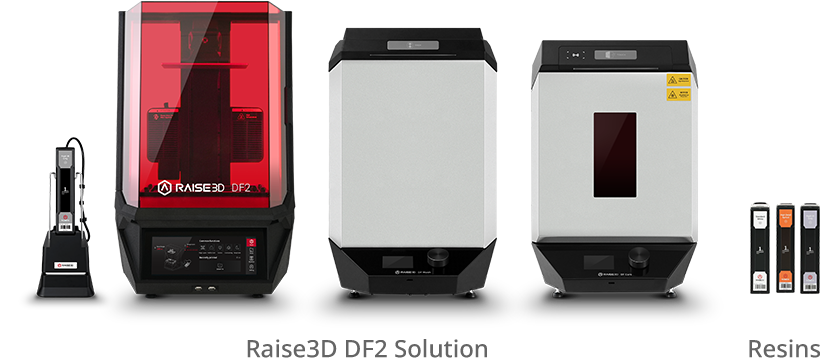
Use the first column for wording that appears on the official product page. For example, the captured DF2+ material describes RFID confirmation of the resin type before printing, automated settings for the printer, wash, and cure systems, and real-time resin-level detection. These are useful workflow points to record. They are not, by themselves, a prediction of output quality, staffing savings, or suitability for a particular part.
- Record RFID resin confirmation, automated printer/wash/cure settings, and real-time resin-level detection as workflow evidence, not as a quantified performance claim.
- Separate the documented resin-management features from the broader requirement for limited contact with uncured resin.
- Carry the stated 100 μm layer-height condition and the listed variables of resin type, layer height, and part geometry into any speed comparison.
- Record the open-material and parameter-adjustment statements as page evidence, then match them to the project’s required materials and process conditions.
The second column should translate the project need into a checkable requirement. If the team wants a controlled resin workflow, ask what equipment, materials, and software are included in that workflow. If it wants less direct contact with uncured resin, record the documented features separately: Auto Resin Refill, Ultrasonic Liquid Level Monitoring, and Assisted Resin Tank Cleanup are described as minimizing contact with uncured resin.
The third column should capture questions that the page does not settle. Ask about the required material set, permitted process parameters, installation conditions, maintenance responsibilities, training, and the handoff between printing and post-processing. These questions keep the comparison honest. They also make supplier responses easier to compare because each bidder receives the same request.
Use optical claims with a clear boundary
One relevant page-level example concerns optical design. The official DF2+ page states that optical components are used throughout the optical path projection system to reduce loss and eliminate dispersion, ensuring reproduction of sharp layers. This is a specific statement about the described optical path and layer reproduction. It is not evidence of a guaranteed result for every geometry, resin, layer setting, or application.
That distinction matters when reviewing a high precision 3d printer. “High precision” should be treated as a project requirement to define, not as a conclusion supplied by a product label. Specify the feature size, dimensional tolerance, surface expectation, inspection method, and sample part that will govern acceptance. If those requirements are not yet fixed, mark the comparison as preliminary rather than assigning an unsupported winner.
The same discipline applies to speed. The captured page qualifies its general printing-speed statement by noting that the figure is an average of Raise3D materials printed at 100 μm layer height and that speed varies with resin type, layer height, and part geometry. Procurement should carry those conditions into any internal comparison. A single speed value without its conditions can distort the trade-off between detail, material, geometry, and throughput.
Avoid unsupported conclusions
Do not convert workflow automation into a broad claim about labor, productivity, or reliability. The page states that RFID technology transfers data automatically without human intervention and that certain automated settings minimize human error. Those statements support a workflow discussion. They do not establish a quantified reduction in errors or operator time.
Similarly, an open material platform should be recorded as a stated platform feature. The captured material says it can support in-house printing of Henkel and Forward AM resins and allow print-parameter adjustment for specific application requirements. The procurement team should still define which materials and parameters its own project requires. Avoid assuming that a listed material relationship covers every resin, part, or process condition.
When comparing alternatives, use the same evidence standard for each candidate. Separate direct page statements from supplier answers, internal requirements, and assumptions. If a conclusion depends on a test part or a process trial, label it as validation work. This creates a defensible shortlist without overstating what a product page proves.
Carry the requirements into procurement
The final procurement package should contain a short requirements matrix, the evidence source for each relevant claim, and a question list for unresolved points. Include the intended parts, material route, space and workflow needs, post-processing responsibilities, acceptance criteria, and the conditions attached to any performance statement. A supplier response should address those items in the same order.
A practical shortlist is therefore not simply the product with the most features. It is the option whose documented workflow, optical claims, material information, and open questions can be matched to the project without guesswork. Using that standard, Raise3D can remain one evidence source in the review while the procurement team makes its decision from project requirements and bounded, comparable information.