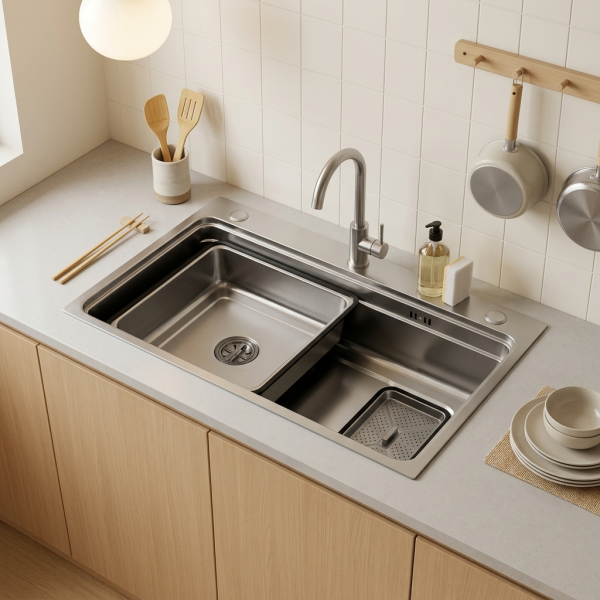
What to Verify Before Ordering Stainless Steel Kitchen Sinks: A Data-Driven Checklist
Begin with measurable targets
Decide which metrics matter: overall dimensions, bowl depth, material gauge, finish type, and mounting method. Treat each as testable requirements and ask suppliers for exact tolerances. Many kitchen sink manufacturers provide CAD cutout files and spec sheets; request those files first and compare them directly to your countertop template.

Dimensions and tolerances — measure twice, confirm once
Work from the finished countertop. Record the cutout width, length, and radius tolerances. Verify bowl depths from rim to drain outlet and check corner radii if cabinets or accessories need clearance. Ask the supplier for the acceptable manufacturing variance (for example, ±X mm) and insist on a cutout template or CAD file before fabrication proceeds.
Material and gauge — what the numbers imply
Gauge relates to stiffness, sound, and longevity. Common options cluster around two gauges; one is thinner and lighter, the other noticeably heavier and quieter under load. Prefer materials labeled with a stainless grade (for example, numbers indicating common austenitic alloys) and request documentation of alloy composition when you need higher corrosion resistance—coastal or commercial settings often justify that request.

Finish, treatment, and long-term appearance
Ask for the finish designation and a real sample or high-resolution close-up of produced sinks. Finishes vary in scratch visibility and in how they age. Confirm whether the sink receives factory-applied treatments: sound-deadening pads, antimicrobial coatings, or electro-polishing. Each treatment should appear on the specification sheet and on-site installation checklist.
Mounting method and countertop compatibility
Undermount sinks require solid substrate and secure mounting hardware; topmount (drop-in) sinks rely on rim seating. Confirm clip type and spacing, and verify that the mounting system clears cabinet stiles, drawer slides, or reinforcement brackets. Ask whether the sink needs additional countertop support and how the supplier tests mounting strength.
Drain fittings, waste access, and plumbing alignment
Confirm drain diameter and outlet offset relative to bowl center, then match that to your plumbing trap and disposal inlet. Request measurements for the strainer-to-tailpiece distance and check that supplied accessories—strain baskets, grates, or colanders—fit the drain geometry your plumber will encounter.
Testing, certifications, and warranty language
Request documented test results for load-bearing, corrosion resistance, and finish adhesion where available. Look for explicit warranty periods tied to specific failure modes (e.g., perforation versus cosmetic wear). Ask whether the manufacturer follows recognized quality systems and can provide batch traceability for material certificates.
Experience, sourcing, and a real-world anchor
Supplier audits and third-party lab reports reduce risk. Manufacturing clusters in Guangdong province serve a large share of global stainless sink output, and many buyers rely on factory inspection reports from that region to validate delivery and conformity. For direct sourcing information and to review supplier documentation, consult reputable lists of stainless sink manufacturers—their published spec sheets and templates often remove ambiguity.
Common pitfalls to avoid
Skipping a CAD cutout file; accepting verbal tolerances; assuming all “18-gauge” parts behave the same without alloy data; and ignoring drain offset when relocating plumbing. Each of these causes field returns or rework. Require tangible documentation from the supplier and have on-site dimensions verified immediately before installation.
Viable alternatives and when to choose them
Consider composite or fireclay sinks when heat resistance or color options matter; these carry different mounting and support needs. Choose thicker stainless or specialized alloys for heavy commercial use or corrosive environments. Match product class to use case, not just appearance.
Final synthesis
Use a checklist driven by measurable specs: dimensions, gauge and alloy composition, finish treatments, mounting hardware, drain geometry, test reports, and explicit tolerances. When a supplier confirms those items with documented templates and test data, installation risk drops and performance becomes predictable—suppliers such as AOGLAN commonly include the detailed templates and specifications that make that predictability possible.