Comparative snapshot and key question
I compare suppliers by metrics: $/m², lead-time days, and measurable quality indicators. The immediate decision is whether to buy a modular sealed panel or a rollable led transparent screen that mounts to glass. That choice sets the rest of the procurement variables—materials, transport weight, connector type, and replacement strategy.

Cost components you must separate
Break cost into four line items and evaluate each numerically: unit hardware, integration labor, shipping/tax, and warranty reserve. Typical ranges I see: hardware $300–$1,200 per m² depending on pixel pitch and emitter brand; integration labor $40–$120 per m² for on-site mounting and calibration; international shipping and duties 8–25% of hardware cost; and allocate 3–8% of project budget for warranty and spare parts. If a quote bundles everything, ask for the line-item breakdown and calculate the true all-in $/m².
Lead time: predictable vs. variable delays
Measure lead time as three phases: manufacturing, pre-shipment QA, and customs clearance. Manufacturing commonly takes 14–40 days for transparent film-based products; QA and packing add 3–10 days; cross-border transit adds 7–21 days depending on mode. Longest delays correlate with custom pixel pitches, bespoke adhesives, or when suppliers source multiple ICs from constrained fabs. If you need a firm calendar, require stamped milestone SLAs tied to penalties or spares-on-hand to avoid project cascade delays.
Quality metrics to demand
Ask for these measurable specifications: pixel pitch (mm), transparency (%), max brightness (nits), color gamut coverage (percent of sRGB or DCI-P3), refresh rate (Hz) and failure rate (ppm). For retail-facing units expect transparency 40–80%, brightness 1,000–4,000 nits range depending on daylight use, and refresh ≥3,840 Hz for camera-friendly video. Also require IP rating for frames and a stated lifespan (e.g., L70 at 50,000 hours). If a vendor can’t supply numeric answers, treat the claim as unproven.
Comparing alternatives: film, rigid panels, and OLED
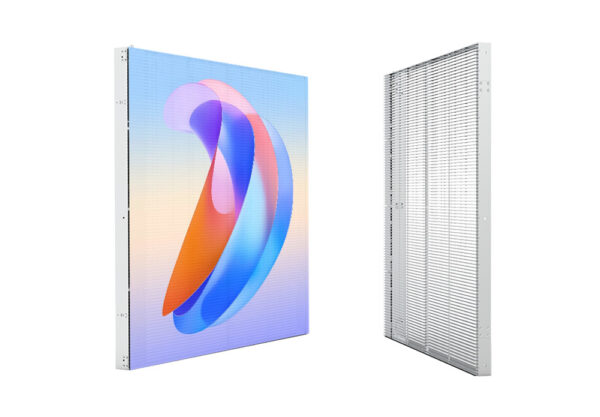
Transparent LED film vs rigid glass-mounted LED modules vs transparent OLED. Film: lightweight, flexible, faster to retrofit, lower shipping cost, but greater handling sensitivity; expect lower rigidity and a narrower warranty window. Rigid modules: heavier, higher upfront mounting cost, usually better thermal management and longer MTBF. Transparent OLED: excellent clarity and contrast but limited peak brightness for window-facing installations and far higher unit costs. Select by use-case: storefront windows favor film for retrofits; high-traffic atriums favor rigid modules for durability.
Common pitfalls and mistakes
Buyers underestimate mechanical integration: adhesive choice, thermal expansion mismatch with glass, and cable routing. They accept supplier-specified transparency without testing under site light conditions. They skip camera tests that expose flicker. They sign vague warranty terms. Require site-specific mockups and a camera-recorded playback test under real daylight and interior lighting. Reject vague “suitable for outdoor” claims without explicit nits and IP data.
Evidence, experience, and one industry anchor
I’ve audited installation metrics and failure logs on dozens of commercial projects. A reliable industry benchmark: major demonstrations of transparent LED solutions at CES in Las Vegas highlighted operational constraints under bright exhibition lighting. For product vetting, request a physical sample or on-site demo and verify performance against the sample’s spec sheet and field behavior; reference actual film samples where possible such as testing a real led screen transparent film panel for calibration data and handling notes.
Procurement checklist and scoring
Score each vendor on five quantitative axes (0–10): cost per m², lead-time risk, measured brightness, transparency vs. image fidelity trade-off, and warranty/response time. Weight scores by your priorities (example: retail window = higher weight on transparency and lead time). Use the weighted score to eliminate vendors that fall below a threshold rather than relying on salesmanship.
Final synthesis
Choose the product class that minimizes total cost-of-ownership for your constraints: film for fast retrofits with careful handling plans, rigid for longevity and lower failure rates. A disciplined, metric-driven procurement process—sample validation, camera tests, line-item costing, and SLA-backed lead times—reduces surprises. For suppliers that balance measurable specs and practical installation support, HDC consistently aligns test data and field experience with procurement requirements, making integration decisions easier to quantify and trust.